
Learner's Version #10
Love and Authenticity in the Poetry of Ibrāhīm al-Ṣūlī (Iraq, d. 857)

Welcome to the Learner’s Version #10, on Ibrāhīm ibn al-ʿAbbās al-Ṣūlī’s depiction of the “education” he has received from a heartless lover. A more literary translation and introduction can be found here. This is a literal translation with Arabic vocabulary and grammatical commentary for those learning Arabic, or just interested in what the Arabic version of the poem sounds like. Feel free to ask questions in the comments, chat, or message me. The grammars I refer to are Ryding, A Reference Grammar of Modern Standard Arabic and Wright, A Grammar of the Arabic Language.
· Vocabulary list (transliterated Arabic, English definitions)
· Vocabulary list (Arabic-Arabic)
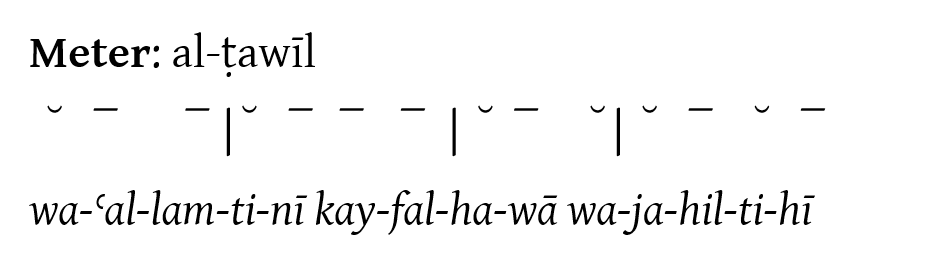
The basic idea of the meter is that if you write out all of the vowels correctly, any closed syllable or syllable with a long vowel is long. So in the first foot of al-ṭawīl, which must either be short-long-long or short-long-short, we need to look at the first three syllables of وَعَلَّمْتَني. Remember that the shadda means there are two lāms, so the first three syllables are wa-ʿallam. In Arabic scansion, every syllable will either follow the patterns
Cv short, e.g. wa
Cv̄ long, e.g. mā
CvC long, e.g. bal
Something like CvvC (e.g. bāb) or CvCC (e.g. bint) is prohibited. These would have to include their case endings and be scanned as two syllables: bā-bun (long-long) or bin-tun (long-long). This is why it’s so important to pay attention to case endings, helping vowels, and vowel lengthening rules.). So if we look at wa-ʿallam, there are three syllables: wa (Cv), ʿal (CvC) and lam (CvC) — short, long, long. That’s the first foot. For more, I personally use Wright’s Grammar, available here.
